
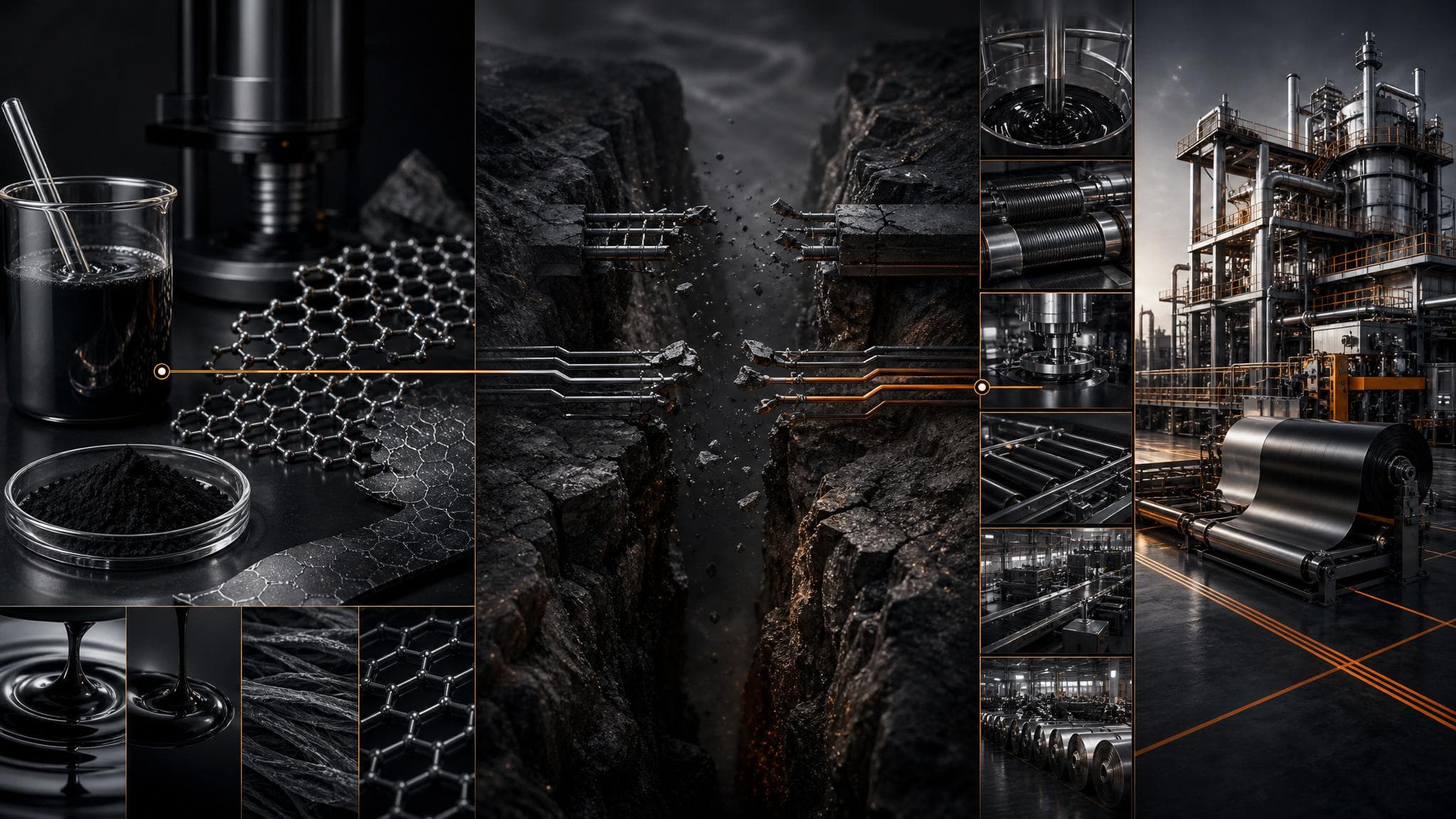
One engineering core built to move graphene into industry.
GraphenCo is structured to reduce the gap between laboratory performance and industrial deployment, so promising material effects can become repeatable, production-ready routes.
Closing the gap between lab performance and factory reality.
In the lab, graphene can show exceptional effects because conditions are controlled, repetitions are precise, and the goal is to prove material potential.
Industrial production is different: scale, process stability, compatibility, and repeatability become the real challenge.
GraphenCo is built to turn proven material potential into a deployable industrial route.
What stays constant from project to project.
The platform is not a collection of isolated experiments. It is a shared operating base for formulation, process design, validation, pilot preparation, and deployment logic across multiple industrial routes.
The platform is built to carry graphene from promising lab behavior into repeatable industrial use. That means clearer integration routes, stronger validation gates, and better fit with production reality.
Translate graphene properties into formulation routes, process windows, and industrially relevant specifications.
Build repeatable deployment paths around dispersion, mixing, QA checkpoints, and production constraints.
Run targeted experiments, formulation adaptation, and contract development for specific client systems.
Grow multiple solution tracks on one shared base, from concrete to coatings, sensing materials, and energy-facing concepts.
A controlled path from material promise to factory readiness.
Each stage is designed to make the transition from lab signal to industrial decision more controlled, more repeatable, and less dependent on one-off trial and error.
Scope the opportunity
Define the target property, commercial value, process constraints, and the tests that will decide whether the route is viable.
Build the integration route
Select graphene type, loading window, dispersion approach, matrix compatibility, and process assumptions.
Validate through testing and QA
Test against agreed criteria, document deltas, and establish repeatability checkpoints that matter for production.
Prepare pilot and scale path
Translate learnings into pilot execution, procurement comfort, QA routines, and a path to operational rollout.
Reinvest into the platform
Each project strengthens a shared knowledge base that accelerates future client work and future vertical businesses.